Delay Lab
See why AR punishes headset delay more than VR, on an ordinary laptop webcam. Add a delay, watch a sticker slide off your nose, measure the slide in pixels, then fix it with prediction.
The idea in 30 seconds
Every headset is a little late
When you move your head, the picture catches up a few milliseconds afterwards.
In VR you can't see it
The whole fake world is late together. You only feel it, as floatiness or, above about 50 ms, sickness.
In AR you can
The real world is never late, so a virtual object visibly slides off the real thing it was stuck to.
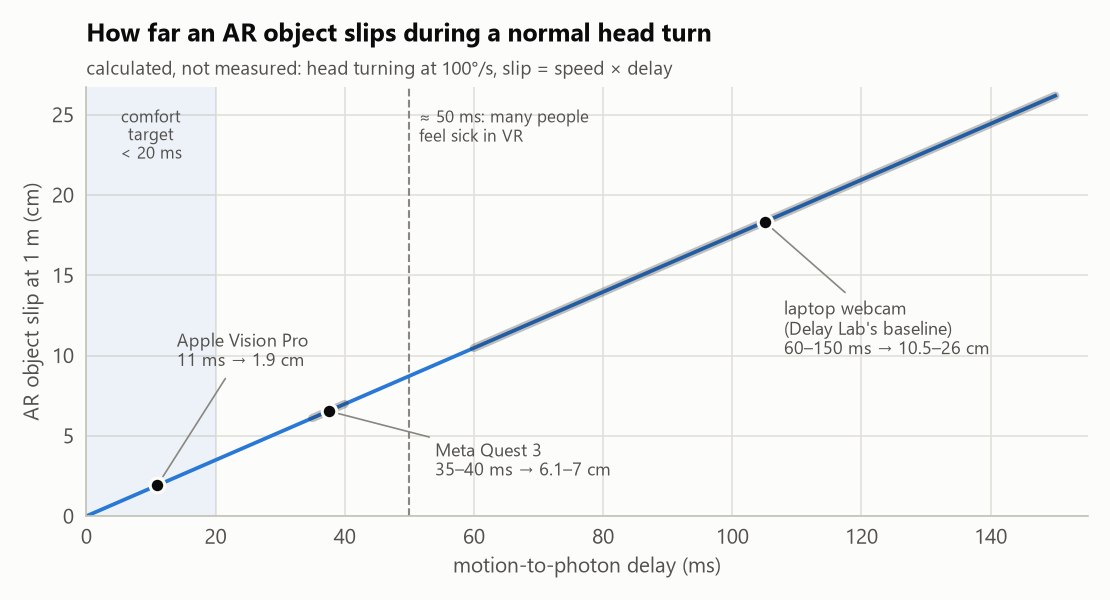
slip = head speed × delay
At a normal 100°/s head turn, 20 ms of delay moves an AR object 1 m away by about 3.5 cm.
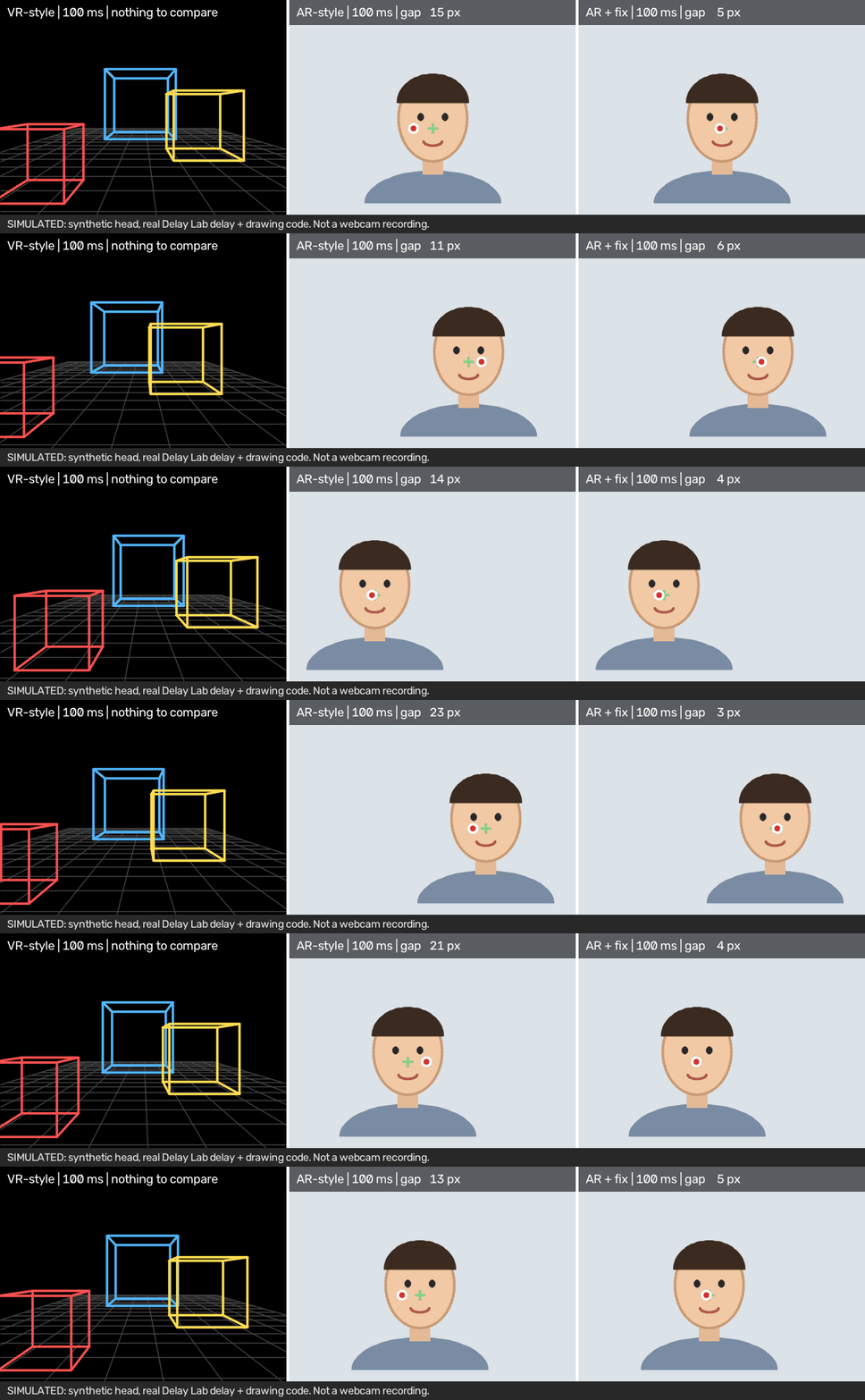
Three modes, one key each
V VR-style
Camera hidden. A wireframe room moves with your delayed head.
A AR-style
Your live face, with a red sticker at the delayed nose position.
F AR + fix
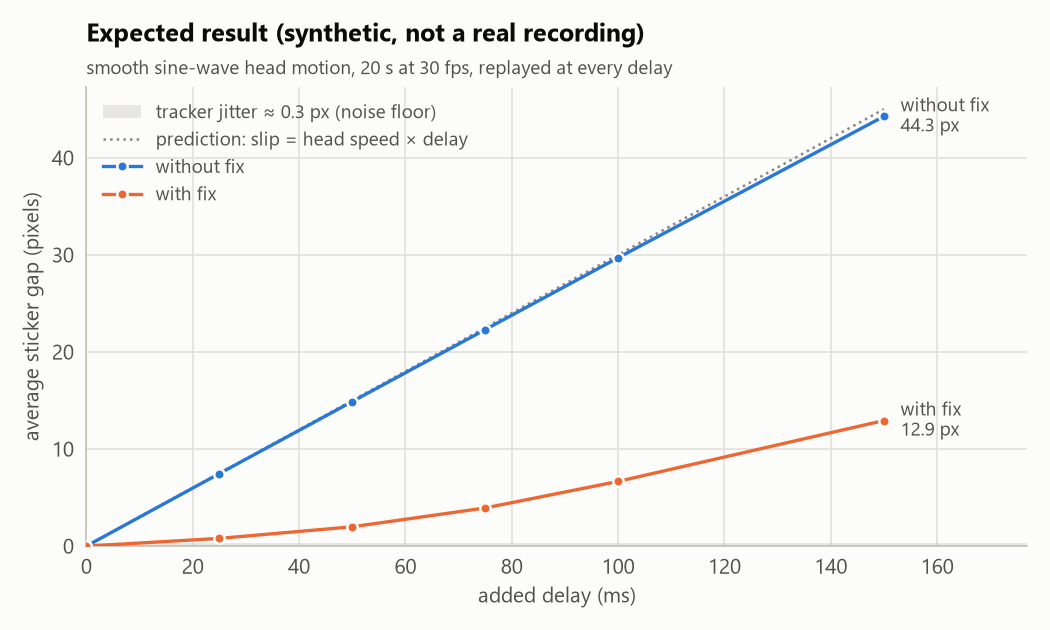
The sticker is drawn where your head is predicted to be: late position + speed × delay.
A slider sets the added delay (0–150 ms). The strip at the top shows the gap between the sticker and your real nose, in pixels.
Where the project stands
✅ Verified: the app runs live on a laptop webcam (~30 fps, face found in ~100% of frames), the packaged exe runs without Python, and 26 tests pass.
⏳ Pending: the 20-second sweep recording the experiment is built around. Want to record the first one?
⚠️ So far: the only real measurement is one 2.5 s self-test clip. That's a first sign, not a result.
Try it
Windows 10/11, a webcam and Python 3.11. Or download DelayLab.exe and skip Python altogether.
py -3.11 -m venv .venv && .venv\Scripts\activate
pip install -r requirements.txt
python download_model.py      # one-time, ~4 MB face model
python app.py                 # or: python app.py --selftest 8
| System | Motion-to-photon delay | AR slip at 1 m (100°/s) |
|---|---|---|
| Comfortable VR target (3GPP TR 26.918) | < ~20 ms | < 3.5 cm |
| Apple Vision Pro passthrough | ~11 ms | ~1.9 cm |
| Meta Quest 3 / Quest Pro / HTC Vive XR Elite | ~35–40 ms | ~6–7 cm |
| A laptop webcam pipeline | ~60–150 ms | ~10–26 cm |
Help out, no webcam needed
The tests run on synthetic head tracks, so you can work on the sweep maths, charts, docs and CI without a camera. Look for good first issues, or ask in Discussions.